A fire, a pinecone, and the choices that remain.
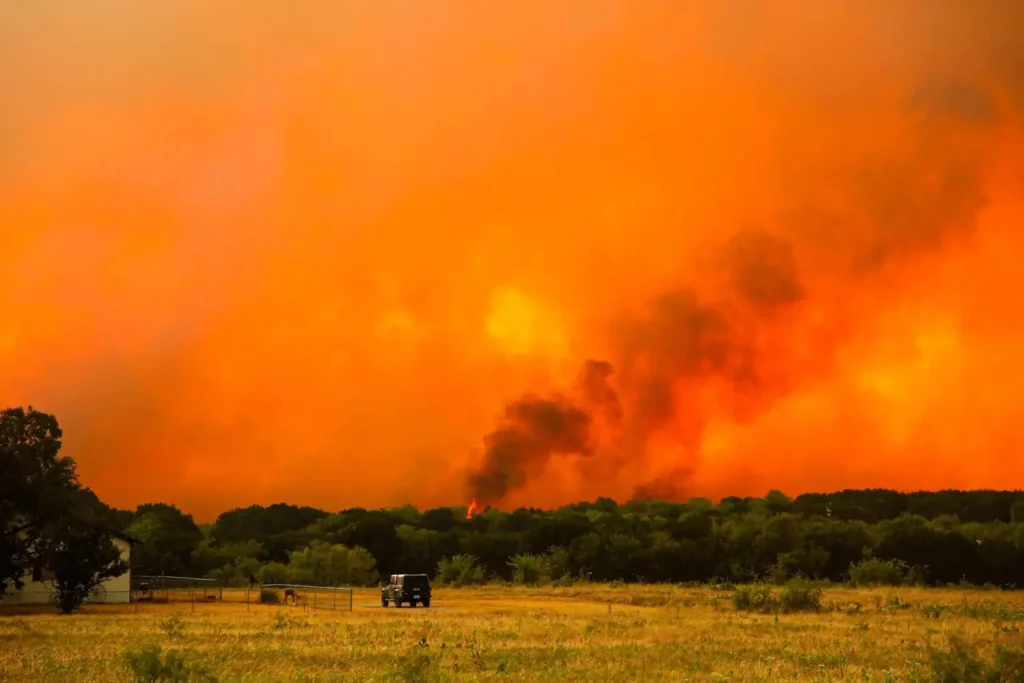
A fire started less than eight miles from my home.
For days, I watched the numbers climb. Acres burned. Containment percentages changed. Smoke settled into the distance. Maps showed the fire spreading across a landscape I know. Some days, the smoke turned the sky yellow and the sun red.
And I was fortunate. The fire moved north.
Not south. Not east. Not toward me.
There was nothing I did to make that happen. No good decision, careful planning, intuition, or strength of character sent the fire in another direction.
It simply went another way.
Fire and I have crossed paths before.
My childhood home burned while I was visiting it many years ago. Later, I stood in Yellowstone nearly a decade after one of its great fires and looked across a landscape that still seemed alien. Time had passed. Life was returning. But the land had not forgotten.
There are things about fire that photographs cannot quite explain: the smell, the noise, the strange color of the sky, the silence afterward. And years later, the sight of charred remains where your memory insists something else should be.
Perhaps that is why I am wary of easy metaphors about rising from the ashes.
There are moments when life makes the limits of our control unmistakably clear. We spend much of our lives learning how to make good choices. We plan. We prepare. We pay attention. We try to protect what matters. We learn from our mistakes and become better at recognizing trouble before it arrives.
All of that matters.
And still, sometimes the fire comes.
Sometimes someone else makes a decision that changes our life. A child grows up and leaves home. A relationship changes. A job ends. A body that has carried us faithfully begins behaving differently. Someone we love needs us in a way we hadn’t expected. A door closes before we have decided whether we were ready to walk through it.
Sometimes there isn’t a decision to make about what happens.
It has already happened.
What remains is our response.
What the Pinecone Knows
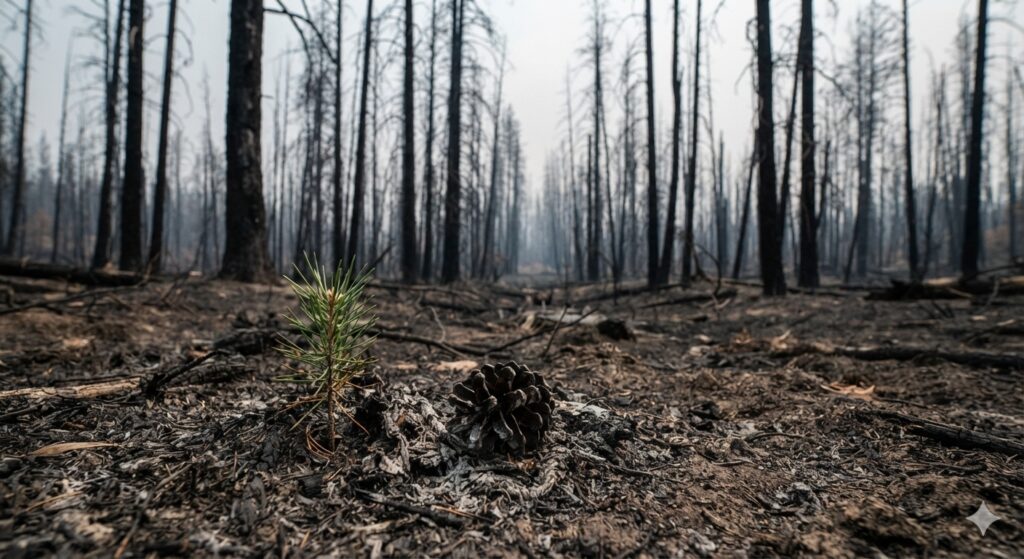
I’ve been thinking about pinecones. They’re silent reminders of loved ones for me. They’re also reminders of a different sort.
Some pine species produce cones that remain tightly closed, sometimes for years. Their seeds wait inside until environmental conditions—including the intense heat associated with wildfire—cause the cones to open.
There is something almost impossible about that image.
The earth is blackened. Trees are scarred or gone. What existed before has been irrevocably changed. Yet somewhere in that landscape, a cone opens.
Seeds fall.
The fire isn’t suddenly good because something grows afterward. Destruction doesn’t become a gift simply because life eventually finds its way through it. Some things are genuinely lost. Some scars remain. And what grows afterward may not look anything like what was there before.
The forest doesn’t rebuild the old forest. It begins again from the conditions that remain. Nature endures and often thrives when least expected.
Perhaps that is the part we sometimes miss when we talk about resilience.
We like stories about rising. We are less comfortable with the part where we crumble first.
When the Choice Wasn’t Yours
The Alchemist archetype has been teaching me something I didn’t expect.
I thought I understood her. She was the one who acted. The decisive woman. The one willing to make the choice when everyone else was still discussing possibilities. She understood that certainty wasn’t required before moving forward.
Make a choice.
See what happens.
Make the next choice.
There is tremendous agency in living that way.
But there is another kind of agency.
Sometimes the first choice isn’t ours.
Life changes the conditions before we have agreed to them. And perhaps the deepest expression of agency isn’t controlling what happens at all. Perhaps it is recognizing what remains ours after something has happened.
Our first reaction may not even belong entirely to us. Biology has something to say about that. We may panic. We may rage. We may grieve. We may sit stunned for a while, unable to imagine what comes next.
We may crumble.
The Alchemist doesn’t require us to rise immediately. She holds steady, allowing us the time to shed the remnants of what was and find our new reality. It is the Alchemist who confirms that sometimes leaving ashes in our wake is the correct option.
She simply waits until another question becomes possible.
What is still mine to choose?
Agency Isn’t Control
There is a seductive idea hidden inside the language of personal power: if we become wise enough, strong enough, prepared enough, or sufficiently self-aware, we can somehow gain the upper hand over life.
But life, nature, and biology have never agreed to those terms.
We cannot control every fire. We cannot make people stay. We cannot stop time. We cannot guarantee that the decisions we make will produce the outcomes we intended. And we cannot always restore what existed before.
That doesn’t leave us powerless.
It asks us to reconsider what power actually is.
Agency isn’t having the upper hand. Agency is recognizing what is still yours to choose.
Take the key off the ring. Make the appointment. Pack the first box.
Say no. Say yes. Ask for help.
Stop waiting for an apology.
Stay. Leave. Rest. Begin again.
Or simply decide that today you aren’t ready to decide anything more.
Sometimes that choice is enormous. Sometimes it is almost ridiculously small.
Take the key off the ring. Make the appointment. Pack the first box.
Say no. Say yes. Ask for help.
Stop waiting for an apology.
Stay. Leave. Rest. Begin again.
Or simply decide that today you aren’t ready to decide anything more.
One choice does not have to rebuild the whole landscape.
It only has to belong to you.
What Grows Afterward
Eventually, the fires burning near my home will be extinguished. The acreage will stop climbing. The containment number will reach 100 percent. The crews will leave.
But the land will remember.
There will be blackened places where something familiar once stood. There will be losses that cannot be transformed into something prettier simply because we would prefer a hopeful ending.
And there will also be life.
Not because the fire was good.
Because life responds.
Perhaps that is what the Alchemist understands. Transformation isn’t always something we initiate. Sometimes it begins when the world changes around us and we discover that the old shape of our life can no longer hold.
We don’t have to call that change a blessing. We don’t have to be grateful for the fire. We don’t even have to emerge from it unchanged and triumphant.
But eventually, when we are able, we can look at what remains and ask:
What is true now?
What is still mine?
What can I make from what remains?
What is the next choice that belongs to me?
The pinecone doesn’t get the upper hand over the fire.
It opens.
And something that had been waiting inside is released.