
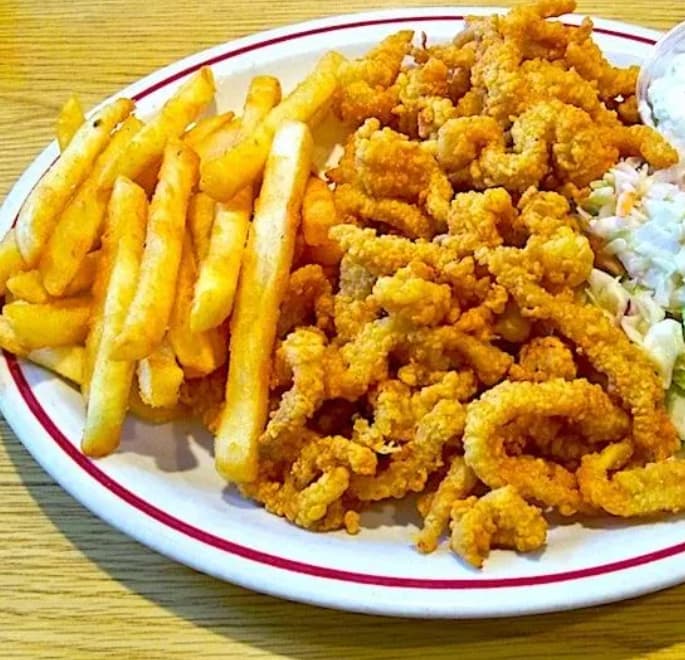
A friendly family disagreement recently sent me down an unexpected rabbit hole. The question was simple enough.
Did Woolworth’s lunch counter really serve Friday night clam plate specials for less than five dollars when I was a newlywed in the early 1970’s?
I remembered those dinners. As newlyweds on a military budget, money was tight, and Friday night at Woolworth’s felt like an indulgence. A date. Nothing fancy—just a chance to sit together, enjoy what felt like a treat, and feel for an hour as though we had all the time in the world. The answer, of course, was yes and easily confirmed thanks to a quick internet search. In fact, the price was most likely under $4.00! It’s always so satisfying to squash the “Right, Mom” eyeroll.
Finding that confirmation brought back more than a menu item. It reminded me of an entire world that now feels surprisingly distant. During my first year of marriage, gasoline cost 35 cents a gallon. Hamburger sold for 19 cents a pound. A perm, in a salon? 10 – 15 dollars. Shoes, groceries, and nearly every other necessity carried price tags that seem almost impossible today.
People often hear numbers like that and assume the story is about inflation.
It isn’t.
The prices aren’t the point.
The point is that I remember that world. And I remember all the worlds that came after it.
I remember card catalogs and encyclopedias.
I remember rotary phones and paper maps.
I remember giant office terminals with glowing green text on black screens.
I remember reading a book called Future Shock and wondering how anyone could possibly live in the world it described. Paying for water with little plastic cards? Nah……
I remember reading books about the internet before most people knew what the internet was. The irony of this amuses me today. A book to learn about the internet.
I remember taking classes to learn how the World Wide Web worked. Most of all, I remember the moment I typed my first HTML code and watched something visual appear on the screen.
It is difficult to explain that feeling now, but the WOW and wonderment stays with me.
Today we expect screens to respond instantly. Images appear with a swipe. Entire worlds fit into our pockets.
Back then, making something appear on a screen felt like magic.
Then came the first graphical browser.
For years, computers had been mostly text. Functional. Useful. A little intimidating.
Suddenly there were images.
Windows.
Links.
Color.
The internet no longer felt like a system.
It felt like a place.
I remember staring at the screen in complete amazement. This was true magic.
The future had arrived.
Or so I thought.
Of course, it wasn’t the future.
It was only one future among many.
The years that followed brought personal computers, email, search engines, smartphones, online teaching, social media, streaming services, and now artificial intelligence.
Each arrived with predictions. Some came true. Many did not.
Most became something nobody had imagined.
And through it all, ordinary people adapted.
That is why I sometimes smile when younger generations assume those of us who grew up in the 1960s and 70s struggle to keep up.
The reality is that we have been keeping up for decades. We have learned new technologies, new customs, new expectations, and entirely new ways of living.
Not once.
Repeatedly.
We Mid-Boomers are in a unique position. We remember both worlds.
The challenge of growing older is not that the world changes.
The challenge is that we remember how many times it has changed.
We carry multiple versions of reality at the same time.
The world of Woolworth’s clam plates.
The world of card catalogs.
The world of dial-up modems announcing their arrival with a scream.
The world of smartphones.
The world of artificial intelligence.
Sometimes I think people mistake that accumulation of memories for confusion.
What I see instead is evidence of adaptation.
Evidence of curiosity. Evidence of imagination.
Evidence of a lifetime spent walking through doors that did not exist when we began.
When I was young, I read books about the future.
Today I live in that future.
Some of it is wonderful. Some of it is bewildering.
Most of it arrived in forms nobody could have predicted.
Yet what surprises me most is not how much the world has changed.
It is how many times ordinary people have adapted and continued forward anyway.
The older I get, the less interested I am in the price of the clam plate.
What matters is something else entirely.
The wonder.
The willingness to look through a newly opened door and ask:
“What happens if I step through?”