(And Other Suspicious Writing Habits)
I have a confession to make.
I love punctuation.
There. I’ve said it.
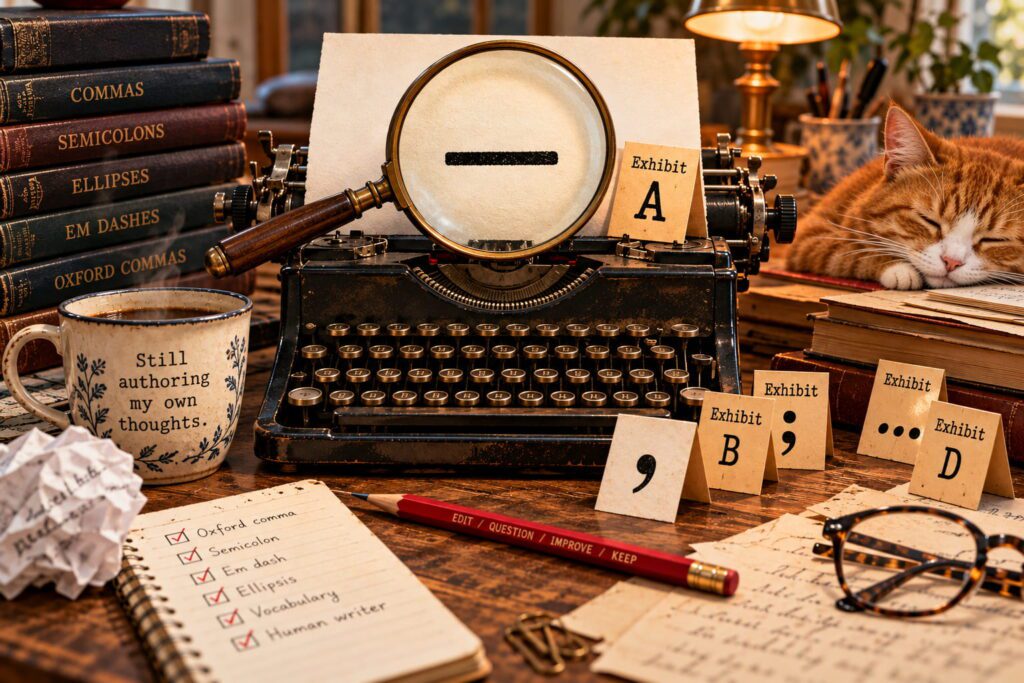
I love Oxford commas, regular commas, semicolons, parentheses, and especially the much-maligned em dash. I even have a fondness for the occasional ellipses…
Punctuation is one of the few tools a writer has to influence your mind. It allows me to create images and experiences that you may never have experienced. It allows me to help you hear the words the way I intended them to be heard. A comma asks you to pause. A period tells you to stop. An em dash—well, an em dash gives me the opportunity to interrupt myself, change direction, or add a thought that simply refuses to wait its turn. Yes, I will admit, I often have thoughts that will not wait and therefore my life is filled with em dashes and ellipses…
Maybe I’m a control freak.
Or maybe I’m just a writer.
I have another confession. I have a pretty good vocabulary. I use words like actually, therefore, consequently, furthermore, game-changer, overall, and delve. Sometimes I even use them in everyday conversation.
I know. Shocking.
I also genuinely love lists. Horrors.
Apparently, these are among the words and writing habits that have become suspicious in the age of artificial intelligence.
The idea that a particular word, punctuation mark, or carefully constructed sentence is a sure sign that something was written by AI is, quite frankly, ludicrous.
(Oh dear. Is ludicrous on somebody’s list of suspicious words?)
I’ve spent many years as a creative writer, business copywriter, editor, website writer, blogger, teacher, and ghostwriter. Words have been my tools for most of my adult life.
And I’ve learned something along the way.
Words matter. So does the way we arrange them.
If I want you to understand the emotion I’m trying to convey, I need to choose my words carefully. If I want you to consider an idea, believe an argument, or even disagree with me, I need to communicate precisely enough that you understand what I’m actually saying.
If I’m writing advertising copy, I want to plant an idea in your mind that might eventually persuade you to make a purchase.
Consequently—oops, there’s another one—I need to understand how language influences thought.
That’s not artificial intelligence.
That’s writing.
And here’s where things become particularly absurd.
I’ve submitted examples of my own writing to websites claiming they can identify whether something was written by a human or generated by AI.
Every single time, these supposedly sophisticated detectors have gotten it wrong.
How do I know?
Because some of those pieces were written in the 1980s and 1990s.
Unless my old typewriter had access to technology nobody knew existed, I think we can safely eliminate artificial intelligence as the author.
Yet here we are, treating polished sentences, thoughtful transitions, and proper punctuation as evidence of something suspicious.
When did knowing how to write become a reason to question whether someone actually did?
And what does that say to the young writers we’re teaching?
Should they avoid expanding their vocabularies? Stop experimenting with sentence structure? Abandon punctuation that helps convey nuance and emotion?
Should we encourage them to write less effectively so their work appears more convincingly human?
What an extraordinary idea.
And here’s another confession. You’d better sit down.
I use AI.
Not because I can’t write, but because I can.
I know what I want to say. I know the voice I want to use. I know when a sentence sounds like me and when it doesn’t.
Artificial intelligence can be a useful assistant. It can help with research, organization, proofreading, and all those tedious little tasks that can interrupt the creative process.
It can catch a missing period, question a misplaced comma, or suggest that perhaps I’ve allowed one sentence to wander a little too far from home.
I can accept or reject those suggestions.
Because I’m the writer.
The ideas are mine. The decisions are mine. The voice is mine.
And the em dash?
That’s mine, too.
So please, calm down.
Human beings really can write.
Some of us enjoy crossword puzzles, word games, and discovering a new word simply because we like the sound of it. Some of us have spent decades learning how to use language to communicate, persuade, entertain, and occasionally provoke.
We don’t need to apologize for knowing how to do it.
And we certainly shouldn’t have to make our writing worse to prove that we’re human.
Furthermore—
Oh, never mind.
You get the idea.
P.S. This essay was proofread with the assistance of artificial intelligence. The irony is not lost on me. Neither were the typos.